
Methylpyrrolidone
( NMPA CDE NO.: F20240000489)
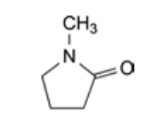
Name: Methylpyrrolidone
Other name: N-Methylpyrrolidone; NMP
M.F.: C5H9NO
M.W.: 99.1
CAS No.: 872-50-4
Packaging: 0.5kg/bottle/carton; 1kg/bottle/carton; 5kg/bottle/carton
Appearance: Clear, colourless liquid, soluble in water and ethanol, miscible with alcohol, ether, ester, ketone, halogenated hydrocarbons and aromatic hydrocarbons
Quality Standard: USP, EP, BP
| EP11.0 | USP-NF2024 | In-house specification | |
| Appearance | Clear, colourless liquid. | Clear, colourless or slightly yellow liquid | Clear, colourless liquid. |
| Boiling point | About 204 °C | About 202°C | About 202~204°C |
| Relative density | About 1.034 | N/A | About 1.030~1.040 |
| Refractive index | About 1.469 | About 1.469 | About 1.460~1.480 |
| 【Identification】 | Comply with Ph. Eur. reference spectrum of N-methylpyrrolidone | Spectroscopic identification tests <197> | Comply with reference spectrum of N-methylpyrrolidone |
| Residue solvent | N/A | N/A | Comply with ICH Q3C |
| Clarity and color | Clarity and colourless | Clarity of solution:The Sample shows the same clarity as that of water, or its opalescence is not more pronounced than that of the Reference suspension.Color of solution:The Sample is not more intensely colored than the Comparison solution. | Clarity and colourless |
| Alkalinity | Not more than 8.0 mL of 0.02 M hydrochloric acid is required. | Not more than 8.0 mL of 0.02 M hydrochloric acid is required. | Not more than 8.0 mL of 0.02 M hydrochloric acid is required. |
| Related substances | Any impurity : maximum 0.1 per cent,Total: maximum 0.3 per cent,Disregard limit: 0.02 per cent. | NMT 0.1% of any individual impurity; and NMT 0.3% of total impurities | NMT 0.1% of any individual impurity; and NMT 0.3% of total impurities |
| Water | ≤ 0.1% | ≤ 0.1% | ≤ 0.1% |
| Heavy metal | N/A | N/A | Not more than 0.0001% |
| Arsenic salt | N/A | N/A | Not more than 0.0002% |
| Microbial limit | N/A | N/A | The total number of aerobic bacteria in each 1ml of the test sample shall not exceed 103 cfu, the total number of molds and yeasts shall not exceed 102 cfu, and Escherichia coli shall not be detected.Optional inspection: Staphylococcus aureus, Pseudomonas aeruginosa, and Candida albicans shall not be detected. |
| 【Content】 | N/A | N/A | 98.0%~102.0% |
| 【Category】 | N/A | Solvents | Pharmaceutical excipients, solvents, etc. |
| 【Storage】 | Protected from light | Preserve in light-resistant containers. | Protected from light |
| Solubility | Miscible with water and with ethanol (96 per cent). | Miscible with water and most organic solvents, including alcohols, ketones, aromatic and chlorinated hydrocarbons. | Miscible with water and with ethanol |
Application:
| Preparation | Application | Dosage |
| Ketoprofen gel patch | API oil phase solvent | 0.5-2% |
| Precipitation type, lyotropic liquid crystal type in situ gel | Solvent/Gel Inhibitor | 30%-70% |
| Oil injection | Co-solvent | 5-10% |
| Freeze-dried microsphere preparation | Oil phase solvent (process solvent) | PLA:PEG-PLA:ethyl acetate:Methylpyrrolidone=3:1:20:25 |
| Preparation of APIs and intermediates | Reaction solvent | – |
① Gel patch: about 1%, total solvent accounts for about 50%, most of which is water;
② In situ gel (sustained release injection): 30% NMP + 30% soybean phosphatidylcholine + 40% dioleylglycerol (lyotropic liquid crystal type); 55~70% NMP + 30~45% PLA/PLGA (precipitation type/solvent exchange type);
③ General injection grade: non-aqueous solvent miscible with water, used as a cosolvent. Intravenous injection is highly toxic and generally not applicable;
④ Process solvent: As a non-protonic cosolvent with low viscosity, good chemical and thermal stability, high polarity, low volatility, and infinite miscibility with a variety of solvents, it can be used as a reaction solvent for the synthesis of a variety of drugs and a process solvent for the preparation of a few poorly soluble API preparations.
Incompatibility: N-Methylpyrrolidone is non-reactive except in the presence of strong acids or bases. It can form complexes with metals, metal basic salts, and some active pharmaceutical ingredients, including benzocaine, phenol, and iodine. It is non-corrosive and biodegradable.